
Checking Criminal History in DeCordova
A DeCordova search should begin with agency identity, not with an assumed DeCordova database. The official DeCordova pages reviewed do not identify a DeCordova Police Department, police report form, DeCordova arrest blotter, or municipal case portal. Hood County Sheriff is the practical law-enforcement route unless the DeCordova city secretary confirms that another agency created the record. The DeCordova booking, court, and DPS layers then follow according to what happened.
Use a measured five-part route. Each step answers a different question and avoids borrowing Granbury’s city forms for a DeCordova event.
- Ask the DeCordova city secretary which agency or court created the requested DeCordova record.
- Contact Hood County Sheriff for a sheriff incident or arrest report, using event details.
- Check Hood County jail for a booking tied to the event.
- Use the County Clerk, District Clerk, or appropriate justice court based on the filed charge.
- Use DPS for reported statewide convictions and deferred adjudications, or FAST for a fingerprint self-review.
DeCordova Has No Verified Record Portal
No official DeCordova police search, court search, arrest log, jail roster, public records form, fee schedule, or mobile app was verified in the research. That absence describes DeCordova’s published access interface. It does not establish that DeCordova records do not exist. A responsive record may sit with Hood County Sheriff, a Hood County clerk, a justice court, or the DeCordova city secretary.
The official DeCordova city website is the best place to confirm current city contacts and government arrangements.

When no search box is available, a focused written request and a custodian referral are more reliable than guessing which neighboring city system might apply.
A DeCordova page may change after publication, so the absence found in the research should be treated as a verified access limitation, not a permanent claim about all future DeCordova services. Confirm the current DeCordova city secretary contact first. If a new contractor, court arrangement, or designated request method is named, follow that official DeCordova direction and keep a copy of the referral with the request.
DeCordova Police Department Records
No municipal DeCordova Police Department was verified from accessible official city material. The page therefore cannot support a police address, records desk, phone number, local background-check product, or police report portal. For a law-enforcement event in DeCordova, identify the responding agency from the report number, dispatch information, citation, or witness paperwork. Hood County Sheriff is the documented fallback when no different creator is shown.
Send a DeCordova request to the office that made the record. The DeCordova city secretary can help identify custody but does not become the holder of a sheriff report merely because the event occurred inside DeCordova. The Hood County Sheriff’s official site is the entry point for current DeCordova records contact information.
DeCordova Criminal Record Request Identifiers
A DeCordova records inquiry should state the DeCordova report or incident number if known, event date and time, exact DeCordova location, involved person, requested document, and delivery preference. These details help the DeCordova city secretary or Hood County custodian locate the right DeCordova event without using a broad name-only search. Avoid sending a Social Security number or other sensitive data unless a verified official DeCordova process specifically requires it.
Ask for one DeCordova record set at a time. An incident report, arrest report, booking sheet, dispatch record, body-camera file, and court case are distinct. If the first office did not create the DeCordova item, request the name of the correct agency. That DeCordova referral is more useful than a simple “no record” response.
A formal DeCordova request should use the designated written method of the agency that holds the item. A call or message to the DeCordova city secretary can identify the DeCordova custodian, but it does not automatically serve as a Texas Public Information Act request to Hood County Sheriff. Once the DeCordova office is known, repeat the narrow event description through its official email, portal, mail, or counter channel. Keep the referral and request date so a later status question can be tied to the correct DeCordova record search.
DeCordova Arrests and Bookings
No DeCordova jail or public arrest blotter was verified. When Hood County Sheriff or another agency makes an arrest tied to DeCordova, the local report stays with that arresting agency. A person accepted into Hood County jail receives a separate county booking entry. That entry may list the arresting agency, initial charges, bond information, custody status, and release data.
A booking is not a conviction, and its charge list is not necessarily the prosecutor’s final filing. If recent custody is the issue, check the Hood jail channel first. If the question is why officers acted, request the agency report. If formal charges were filed, move to the correct Hood County clerk. The county-wide arrest lookup gives that broader routing context.
DeCordova Records Without a Blotter
DeCordova can have police-related events without publishing a daily log. DeCordova’s lack of a verified blotter makes dates, locations, and agency names especially important. Start with any DeCordova paper already in hand. A citation names an issuing authority and court. A bond sheet may name the booking facility. A DeCordova incident number often carries an agency prefix or format that staff can recognize.
If no document is available, describe the event to the city secretary at cityofdcsecretary@gmail.com and ask who would hold the record. Meetings are held at 5301 Country Club Drive, Granbury, TX 76049, but current submission methods should be confirmed on the city site before sending a formal request. Telephone questions can locate a custodian, while a durable Texas Public Information Act request should use a designated written method.
If Hood County Sheriff is identified, ask separately for the agency report and any jail booking sheet. If the DeCordova event produced a fine-only citation, confirm the issuing justice or other court rather than sending it to the felony portal. A Class A or B misdemeanor belongs with the County Clerk, and a felony belongs with the District Clerk. The county's official document center is a forms and records repository, but it should not be mistaken for a complete criminal search. This DeCordova fallback chain is longer than an online blotter, but it preserves the DeCordova record’s creator, date, and legal level.
Municipal Court Records in DeCordova
No DeCordova municipal court, clerk interface, docket portal, published fee schedule, or municipal-court form was verified in the official sources reviewed. Do not invent a court record from the city’s incorporated status. Ask the city secretary whether a city ordinance matter exists and which court maintains it. If the matter is a fine-only state-law case outside a verified municipal docket, the appropriate Hood County justice court may be the correct route.
Class A and B misdemeanors go through the Hood County Clerk, while felonies go through the District Clerk. Those are county courts, not DeCordova offices.
A justice court may hold a DeCordova fine-only matter that never appears in a district felony search. The issuing DeCordova citation, complaint, or notice is the best evidence of the proper court. If none is available, give the DeCordova city secretary the event date and location and ask for the court name before searching county systems at random.
| Court Name | No DeCordova municipal court verified in accessible official sources |
|---|---|
| Case Types Heard | Ask the city secretary whether any ordinance matter exists and which court received it |
| Case Lookup Channel | City-secretary referral, then the identified justice, county, or district clerk |
| What the Docket Shows | Depends on the actual issuing court; no DeCordova docket display was verified |
| Copies & Fees | Request from the identified clerk; no DeCordova schedule was located |
Granbury Forms Do Not Cover DeCordova
Granbury publishes a police records form, but that form is city-limited. It should not be used as though Granbury Police keeps DeCordova reports. The two cities have separate municipal governments, and Hood County’s shared geography does not merge their local files. A request sent to the wrong city may delay the search or return no result.
DeCordova’s correct fallback is to identify the responding agency through the city secretary and event paperwork. If Hood County Sheriff created the report, use the Sheriff’s designated records route. If a Hood court filed the case, use that clerk. If the event never became a filed case, a clerk search may be silent even when an agency report exists.
Where DeCordova Criminal Records Go
Because no DeCordova police department was verified, the local record flow must begin with the actual responding agency. That agency creates the incident or arrest report. Hood County jail creates a booking when it accepts the person. The prosecutor may then file in the proper Hood court, and final reportable events can reach the Texas Department of Public Safety.
Record flow: Responding law-enforcement agency › Hood County Courts › Texas Department of Public Safety
The DPS public name search shows reported convictions and deferred adjudications, not every DeCordova police contact. A fingerprint-based self-review through FAST is the stronger identity check. County and state detail should be confirmed through the broader Hood County criminal history resource when the city referral is only the start.
A missing DPS name result does not close the local search. The DeCordova event may be too recent, may not have led to a filed charge, or may have a disposition that has not yet reached the repository. Match any DeCordova state result to the DeCordova date and Hood court cause, and obtain a certified disposition from the correct clerk when the outcome matters.
DeCordova Minutes Verify City Arrangements
Official meeting minutes and agendas can help confirm who currently performs a city function when a small municipality does not publish a department directory. They may show appointments, contracts, security measures, or service arrangements. They are not a criminal-case search and should not be treated as an arrest log.
The city’s minutes and agendas archive is a primary source for those government arrangements.
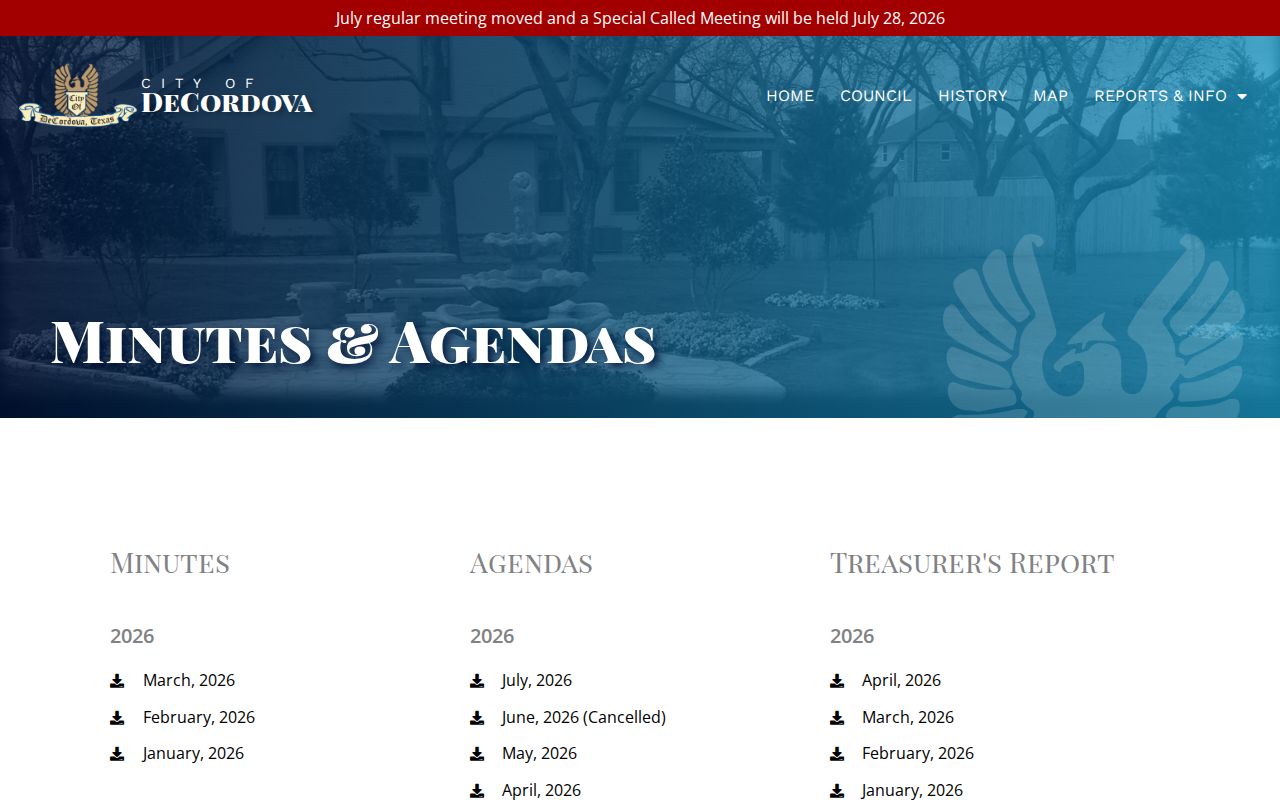
Use the archive to identify a current office or agreement, then request the actual law-enforcement or court record from its named custodian.
DeCordova Criminal Records in Context
The official Texas Demographic Center place estimates provide the update source for small municipalities, while the common 2020 Census benchmark placed DeCordova at 3,169 residents. That figure describes the city’s population baseline, not its crime rate, records volume, or law-enforcement structure. It also does not justify assuming that a city of this size operates its own police department or municipal court. Official sources must establish those facts separately.
The lakeside setting can also make an address seem more informative than it is. A DeCordova mailing location does not identify which agency answered a call or which court later received a charge. Use the record creator shown on event paperwork, and let the 2020 count remain population context rather than a shortcut for claims about crime or record access.
The official Hood County homepage supplies county-government context for the offices that often serve DeCordova events.
This county layer matters because sheriff reports, bookings, and higher-level cases may never appear on the DeCordova city site. Address precision also matters in the lakeside community when using the Texas Public Sex Offender Registry. A tight map radius can miss a rural or imperfectly geocoded location. Search by Hood County as well as DeCordova, then direct a suspected address or status error to the responsible local registering authority. The DeCordova public map view is a safety and notification tool, not proof of which office wrote an unrelated police report.
Public Access Rules in DeCordova
The Texas Public Information Act applies to city and sheriff administrative records, subject to exceptions and each body’s designated request methods. A governmental body must respond promptly, but “promptly” is not a fixed ten-business-day delivery promise. Active investigative material, protected victim details, juvenile information, and personal identifiers may be withheld or redacted. Court files follow judicial access rules through the actual clerk instead.
DeCordova’s sparse online interface makes correct routing part of public access. Ask who created the item, document the referral, and use that office’s official channel.
Key Statutes:
Texas Government Code Chapter 552 governs public requests, response duties, designated methods, and law-enforcement exceptions.
Texas Government Code Chapter 411 limits criminal-history dissemination while authorizing the public DPS product.
Texas judicial access rules govern court files, sealing, and redaction rather than the ordinary TPIA process.