
Hood County Criminal Court Cases
Hood County criminal court records divide first by jurisdiction. The Hood County District Clerk keeps felony files for the 355th Judicial District Court. The Hood County Court at Law hears Class A and Class B misdemeanors, with its files held by the County Clerk. Both offices use the county complex at 1200 W. Pearl Street in Granbury. The County Clerk can be reached at 817-579-3222 or countyclerk@hoodcounty.texas.gov. The District Clerk lists districtclerk@hoodcounty.texas.gov. The state judiciary's current district-clerk directory and county-clerk directory verify those routes; confirm the District Clerk's direct line on the official office page.
Fine-only state offenses and city ordinance cases belong at the municipal or justice-court level. Granbury Municipal Court may also hold a capias or failure-to-appear event tied to its own case. The constitutional County Court has limited statutory work, but state court data does not place ordinary criminal filings there. Naming the offense level, court, and approximate year prevents a request for Hood County case records from reaching the wrong counter.
Hood County Court Levels Compared
A Hood County booking label does not choose the final court. Prosecutor review can change the alleged grade before a charging instrument is filed. A Hood County felony normally proceeds by grand-jury indictment in District Court, while a Hood County Class A or B misdemeanor commonly proceeds by an information in County Court at Law. A Class C case may never enter either clerk's criminal case index. Texas Penal Code Chapter 12 defines the offense levels and punishment ranges that help route the case.
| Hood County court | Criminal work | Custodian |
|---|---|---|
| 355th Judicial District Court | Felonies and district post-judgment matters | District Clerk |
| County Court at Law | Class A and B misdemeanors; juvenile matters | County Clerk |
| Municipal and justice courts | Fine-only offenses and court-issued process | Issuing court |
Juvenile files have separate access limits even when the County Clerk is the custodian. Ask about public-access status before ordering a juvenile record.
Searching Hood County Case Records
The Hood Odyssey Public Access portal is the main remote route for District Clerk judicial records. Anonymous functions and document visibility can vary by role or session. Hood County misdemeanor searches may require the County Clerk's NetData channel, an index request, or help at the counter. The re:SearchTX platform provides a statewide court layer, but participation and document coverage vary. It is not a complete substitute for either Hood clerk.
- Decide whether the filed matter is felony, Class A or B misdemeanor, or fine-only, then choose the matching Hood County custodian.
- Use the exact cause number in Odyssey when known. Otherwise search the party name, try spelling variants, and narrow by filed date or court.
- Open each count and its register of actions. A hearing setting or warrant entry is not the final outcome.
- Order the charging instrument and judgment from the clerk when the summary does not answer the charge or disposition question.
- Ask for an archived, paper, index, or microfilm search when an older Hood County criminal case is absent online.
| Field label | Type | Required | Format or use |
|---|---|---|---|
| Search type | Tabs or menu | Yes | Case, Party, or Attorney when available |
| Case Number | Text | No | Use the exact Hood cause number |
| First, Middle, Last Name | Text | No | Try full name and spelling variants |
| Date of Birth | Date | Varies | May be limited in the public view |
| Filed Date From / To | Date | No | Narrows common names |
| Case Type / Court | Dropdown | No | Shows only courts published to the portal |
Note: Hood County copy, search, and certification fees were not found in a current official schedule, so confirm cost before ordering.
Hood County Case Search in Odyssey
The Hood Odyssey result is case-centered. A header can show the cause number, court, case type, filed date, and status, while the charge panel can separate several counts with distinct outcomes. The events register records filings, settings, counsel, motions, pleas, orders, judgments, sentences, and public warrant or capias events. Financial fields may show assessed costs, fines, or balances if this deployment publishes them. Document titles can appear even when the image itself needs a login, clerk order, or fee.
The official Hood Odyssey interface is shown here as the county portal readers should recognize.
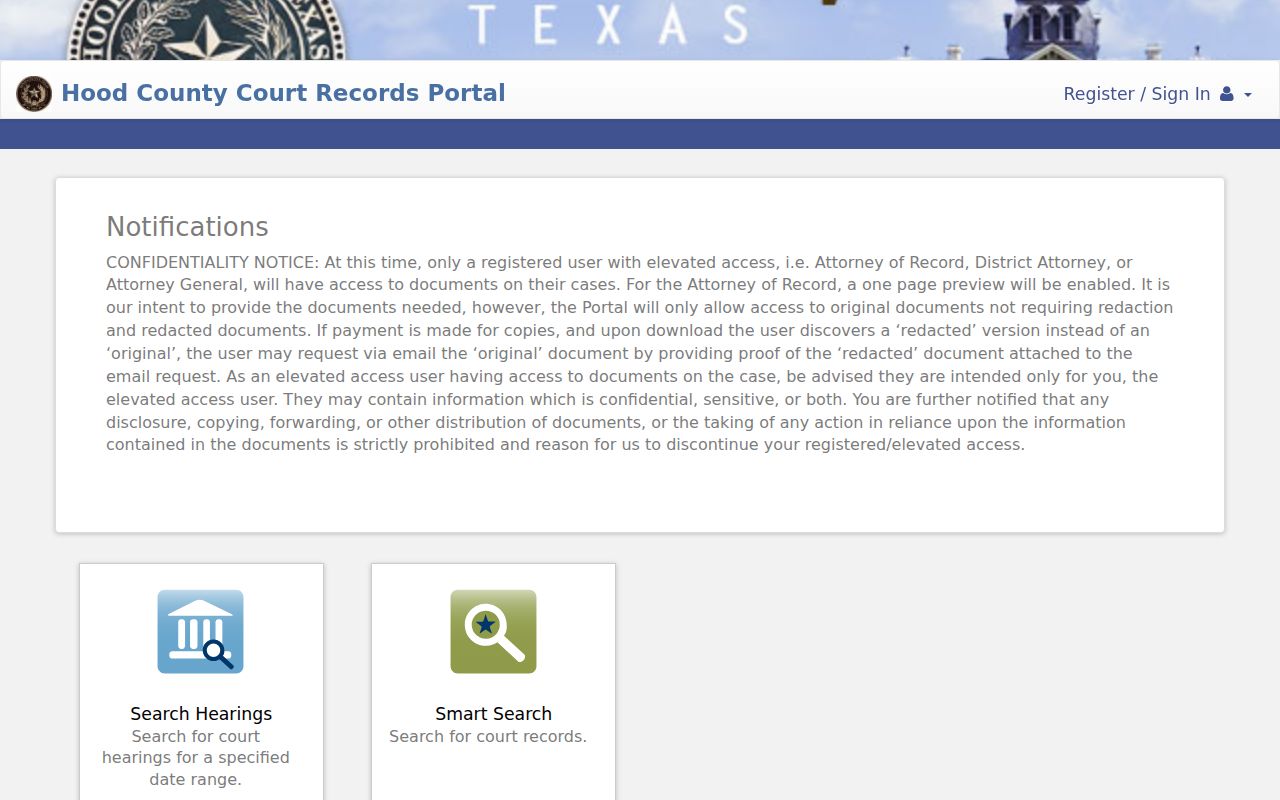
The screen is an entry point, not a certified court record. A clerk-issued judgment or charging instrument carries more authority than a saved portal image.
Inside a Hood County Case File
A Hood County criminal case file grows as the prosecution moves. The complaint or indictment states the charge being pursued, while the docket shows what the parties and court did over time. Read all counts because one can be dismissed while another ends in a plea or verdict. A status word at the case level can hide that difference.
| Case Number and Court | Identifies the cause and the Hood County court with custody of the file. |
|---|---|
| Charging Document | Complaint, information, or indictment stating the filed allegations. |
| Charge Panel | Count, description, statute, grade, offense date, status, and disposition where entered. |
| Docket Entries | Chronological filings, settings, appearances, motions, pleas, orders, and warrant events. |
| Hearings | Date, type, court, and judicial officer when published. |
| Disposition and Judgment | The result of each charge and the court's formal ruling. |
| Sentence and Costs | Custody, community supervision, fine, court costs, and later revocation activity when public. |
Full dates of birth, Social Security numbers, financial-account data, protected victim or minor details, and sealed or expunged records should not appear in a public Hood County case view.
Read Hood County Case Counts
One cause can contain several charges. Check the sequence number, the filed offense text, and the disposition for each count. “Dismissed” means the court charge ended without a conviction; it does not mean the arrest record vanished. “Acquitted” means a not-guilty result. A “no-bill” means the grand jury declined to indict the presentation. Deferred adjudication places a person on community supervision without an immediate judgment of guilt, but it is not an acquittal and can remain publicly reportable unless a nondisclosure order applies.
- Disposition
- The outcome of a particular charge or case.
- Docket
- The dated list of case events and filings.
- Capias
- A court order directing an arrest, often after a procedural default or judgment.
- True bill
- A grand jury's approval of an indictment.
- Judgment
- The court's formal statement of the result and sentence.
When a portal summary is unclear, ask the Hood County clerk for the filed charging instrument and final judgment. Those two records usually resolve what was alleged and how the charge ended.
How a Criminal Case Moves
A Hood County felony often moves from arrest and magistration to prosecutor review and a grand-jury decision. A true bill opens the indictment path in the 355th District Court. Class A and B misdemeanor charges usually proceed by information in County Court at Law. Texas law requires magistration without needless delay and ordinarily within 48 hours, but that hearing addresses rights, probable cause, counsel, and bail rather than guilt at trial.
Case flow: Charges Filed › Arraignment › Pretrial › Plea or Trial › Disposition › Sentencing
Later events may include a motion to revoke community supervision, a motion to adjudicate deferred supervision, a capias, or an appeal notice. These become part of the Hood County court record even though the related arrest or custody entry remains with another agency. Code of Criminal Procedure Chapter 66 supplies the state reporting framework that connects qualifying court outcomes to criminal-history systems.
A court setting is only a scheduled event. Check the next docket entry to learn whether it occurred, moved, or resulted in an order. The final judgment and sentence remain the strongest records for the outcome.
Hood County Cases on re:SearchTX
The statewide re:SearchTX service can help when a person has matters in more than one Texas court. Coverage depends on each court's participation and the user's role, so absence is not proof that Hood County has no file. Search the county clerk systems and contact the proper clerk before drawing that conclusion.
The statewide court platform appears below.
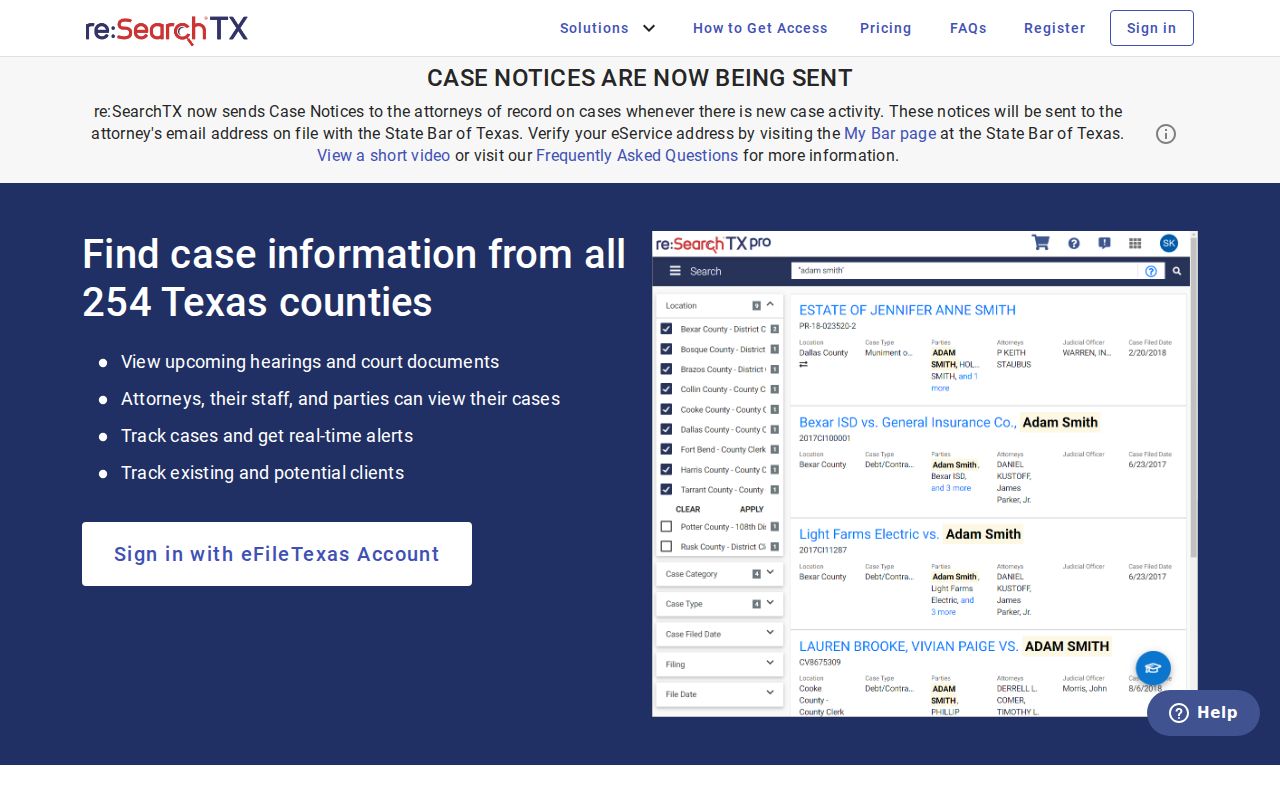
Use the statewide result to locate a court, then return to the Hood County custodian for certified copies and local archive help.
Archived Hood County Criminal Cases
Hood County criminal records extend far beyond the practical horizon of a modern portal. The Texas State Library Hood County microfilm inventory lists county-court minutes from 1876 through 1912. Volumes E, G, and I are exclusively criminal minutes. That archive matters for genealogy and historical research because a name can be absent from Odyssey yet still appear in a surviving court volume.
Give the clerk or archive an approximate year, full name, court, and offense when possible. Ask whether the source is indexed and whether the needed page can be certified. A portal screen cannot replace a certified archival copy.
Note: The historic courthouse is important context, but modern Hood County record requests often route to offices at West Pearl Street.
Case Record Access & Restrictions
Texas court files are presumptively accessible under the judiciary's court-record rules and standards, subject to sealing, redaction, and category-specific limits. Judicial case files are not requested from a clerk through the Texas Public Information Act in the same way as a sheriff's executive-agency records. Ask the court clerk for inspection, copies, or certification under the rules that govern judicial records.
Juvenile matters, sealed or expunged cases, grand-jury deliberations, protected victim identities, and full personal identifiers can be unavailable. A document image may also be withheld from the web while remaining inspectable at the clerk's counter. If a Hood County criminal case does not appear, ask whether it is archived, paper-only, restricted, or filed in another court. For the broader distinction between an arrest event and the later file, consult the Hood County arrest lookup.
Hood County clerk staff can also explain whether inspection, a plain copy, or a certified copy fits the request. Federal prosecutions instead belong to the U.S. District Court for the Northern District of Texas and do not enter a Hood County clerk portal.
Access rule: Government Code Chapter 552 governs agency records, while Texas judicial rules govern court files; use the custodian and process that match the record.